Parkinson’s Physical Therapy in Central Florida
Helping people with Parkinson’s move better, walk safer, reduce fall risk, and stay more independent at home.
Call Harry Physical Therapy & Wellness
Learn More About Our Parkinson’s Program
Parkinson’s disease can slowly change the way a person walks, stands, turns, transfers, and moves through daily life. Families may notice smaller steps, shuffling, freezing, stiffness, poor posture, balance problems, or a growing fear of falling.
At Harry Physical Therapy & Wellness, we provide Parkinson’s-focused physical therapy for older adults throughout Central Florida. Our team helps individuals with Parkinson’s improve mobility, reduce fall risk, build confidence, and maintain as much independence as possible at home.
We offer in-home, in-clinic, and virtual therapy options for individuals and families who need practical, personalized support.
Call Harry Physical Therapy & Wellness today to learn how Parkinson’s physical therapy may help you or your loved one.
Physical Therapy for Parkinson’s Disease
Parkinson’s disease affects more than movement speed. It can impact balance, posture, walking, coordination, endurance, transfers, turning, and confidence with everyday activities.
Over time, people with Parkinson’s may begin to move less, avoid walking, rely more on caregivers, or become afraid of falling. Physical therapy can help by creating a structured plan focused on movement quality, safety, strength, balance, and daily function.
At Harry Physical Therapy & Wellness, Parkinson’s therapy is designed around real-life goals, such as getting out of a chair, walking across the home, turning safely, getting in and out of bed, using a walker correctly, and reducing caregiver burden.
Common Parkinson’s Mobility Problems We Address
How Harry Physical Therapy & Wellness Helps
Parkinson’s-specific movement training
Gait and walking practice
Balance and fall prevention
Freezing strategies
Transfer training
Posture and strength exercises
Assistive device training
Caregiver education
Home safety recommendations
We focus on practical improvements that matter in daily life, not just exercises that look good in a clinic.
In-Home Parkinson’s Physical Therapy
Many people with Parkinson’s have the most difficulty inside their own homes. That is why in-home therapy can be especially valuable.
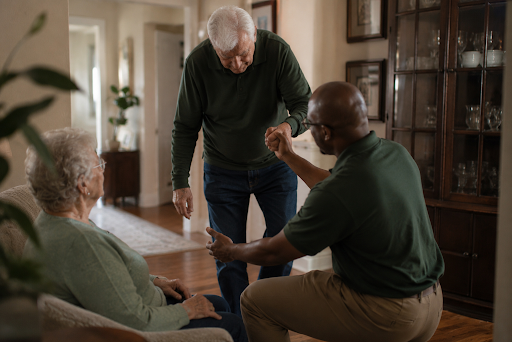
In the home, we can work directly on the actual areas where problems occur, such as the bedroom, bathroom, hallway, kitchen, living room, garage, or front entrance.
In-home Parkinson’s therapy may help with:
Walking safely through the home
Getting out of bed
Standing from chairs
Reducing fall risks in tight spaces
Improving bathroom safety
Practicing turns in real environments
Training caregivers on safer ways to assist
Recommending home safety changes
This allows therapy to be more practical, realistic, and specific to the person’s daily routine.
Helping Families and Caregivers
Parkinson’s does not only affect the person diagnosed. It also affects spouses, adult children, and caregivers.
Families often ask:
Is my loved one safe walking at home?
Why are they falling more often?
Should they be using a walker?
How can we help without pulling or lifting incorrectly?
What exercises are safe?
What should we change inside the home?
Is this normal progression, or should we get help now?
Harry Physical Therapy & Wellness helps families better understand mobility changes and gives practical strategies to support safety, independence, and quality of life.
Who May Benefit From Parkinson’s Physical Therapy?
Parkinson’s physical therapy may be appropriate if you or your loved one has:
A diagnosis of Parkinson’s disease
Shuffling or smaller steps
Difficulty walking or turning
Freezing episodes
Falls or near falls
Declining balance
Stiffness or slower movement
Trouble standing from a chair
Difficulty moving around the home
Increased caregiver assistance
Fear of falling
Reduced confidence with daily activities
Therapy can be helpful in early, middle, and later stages of Parkinson’s disease. The goals may change over time, but movement, safety, function, and caregiver support remain important.
Explore Parkinson’s Therapy Options
Why Choose Harry Physical Therapy & Wellness?
Parkinson’s-focused experience
LSVT BIG and PWR! Moves training
In-home, in-clinic, and virtual options
Older adult and caregiver-centered care
Central Florida service area
Virtual Services offered
Practical home-based solutions
Take the Next Step
If you are concerned about Parkinson’s-related walking problems, balance changes, freezing, falls, weakness, or safety at home, Harry Physical Therapy & Wellness can help.
Call Harry Physical Therapy & Wellness today to discuss Parkinson’s physical therapy in Central Florida.
You can also learn more about our Parkinson’s-focused programs and support options here:
Learn More About Our Parkinson’s Program
Frequently Asked Questions
Can physical therapy help Parkinson’s disease?
Physical therapy cannot cure Parkinson’s disease, but it can help people work on walking, balance, posture, transfers, strength, endurance, fall prevention, and movement confidence.
When should someone with Parkinson’s start physical therapy?
Physical therapy can be helpful early after diagnosis, when symptoms begin affecting movement, or later when walking, balance, falls, or daily function become more difficult.
Do you provide Parkinson’s therapy at home?
Yes. Harry Physical Therapy & Wellness provides in-home physical therapy for individuals with Parkinson’s throughout Central Florida. We also offer in-clinic and virtual options.
Can therapy help with freezing of gait?
Physical therapy may help individuals learn strategies for managing freezing episodes, improving step initiation, turning more safely, and reducing fall risk.
Do you work with caregivers?
Yes. Caregiver education is an important part of Parkinson’s therapy. We help families understand safer ways to assist with walking, transfers, home safety, and daily movement.
Is Parkinson’s therapy only for advanced Parkinson’s disease?
No. Therapy can be helpful at many stages of Parkinson’s disease. Early therapy may focus on maintaining strength, mobility, posture, and confidence. Later therapy may focus more on safety, caregiver support, transfers, and fall prevention.
Shuffling Steps
Small, short steps that make walking slower, less steady, or more difficult to control.
Falls or Near Falls
Recent falls, close calls, or fear of falling that limits confidence and daily activity.
Posture Changes
Forward posture, stiffness, or difficulty staying upright during walking and daily movement.
Freezing of Gait
Feeling stuck when starting to walk, turning, approaching doorways, or moving through tight spaces.
Trouble Turning
Difficulty turning safely in hallways, bathrooms, bedrooms, kitchens, or small spaces.
Weakness and Reduced Endurance
Getting tired, walking less, or avoiding daily activities because movement feels harder.
Poor Balance
Unsteadiness with standing, walking, reaching, turning, or changing direction.
Difficulty Standing From a Chair
Needing multiple attempts, extra help, or pulling on furniture to stand up.
Caregiver Safety Concerns
Family members feeling unsure how to help with walking, transfers, and falls.